The celestial dance of moon and stars has captivated poets across centuries, inspiring verses that transform night sky observations into profound literary art. These luminous orbs continue sparking creativity in writers who find endless metaphors within their silvery radiance and twinkling brilliance. This comprehensive collection presents over twenty-six extraordinary poems about the moon and stars, showcasing how astronomical wonder becomes timeless poetry.
The Moon by Percy Bysshe Shelley
And, like a dying lady lean and pale,
Who totters forth, wrapp’d in a gauzy veil,
Out of her chamber, led by the insane
And feeble wanderings of her fading brain
Percy Bysshe Shelley’s haunting portrayal transforms the waning moon into a fragile, ethereal figure wandering through darkness. His romantic imagery captures the moon’s pale luminescence while exploring themes of mortality and transience that resonate throughout his body of work.
The poet’s masterful use of personification creates an unforgettable visual of lunar beauty intertwined with human vulnerability, establishing this piece as one of literature’s most poignant moon poems.
When I Heard the Learn’d Astronomer by Walt Whitman
When I heard the learn’d astronomer,
When the proofs, the figures, were ranged in columns before me,
When I was shown the charts and diagrams, to add, divide,
and measure them,
When I sitting heard the astronomer where he lectured with
much applause in the lecture-room
Walt Whitman contrasts scientific analysis with personal celestial experience, suggesting that astronomical wonder transcends mathematical calculations. His free verse style mirrors the spontaneous joy discovered when stepping away from academic discourse to witness starry magnificence directly.
This profound meditation on stellar observation versus intellectual study remains relevant for modern readers seeking authentic connections with the night sky’s beauty.
Stars by Sara Teasdale
Alone in the night
On a dark hill
With pines around me
Spicy and still
Sara Teasdale’s delicate verses celebrate the intimate relationship between solitary observers and stellar companions. Her economical language captures profound emotional depth while painting vivid scenes of nocturnal contemplation beneath twinkling constellations.
The poem’s minimalist approach demonstrates how celestial poetry can achieve maximum impact through carefully chosen words that evoke universal experiences of cosmic wonder.
The Starlight Night by Gerard Manley Hopkins
Look at the stars! look, look up at the skies!
O look at all the fire-folk sitting in the air!
The bright boroughs, the circle-citadels there!
Down in dim woods the diamond delves! the elves’-eyes!
Gerard Manley Hopkins employs his signature sprung rhythm and innovative vocabulary to create an exuberant celebration of stellar beauty. His neologisms and alliterative patterns mirror the sparkling energy of stars themselves.
This Victorian masterpiece transforms astronomical observation into spiritual revelation, demonstrating how poems about stars can bridge earthly experience with divine transcendence.
Bright Star by John Keats

Bright star, would I were stedfast as thou art—
Not in lone splendour hung aloft the night
And watching, with eternal lids apart,
Like nature’s patient, sleepless Eyelid
John Keats addresses a single brilliant star as both celestial beacon and symbol of desired permanence. His Shakespearean sonnet explores the paradox of wanting stellar constancy while maintaining human passion and connection.
The poem’s romantic intensity and astronomical imagery create one of literature’s most beloved star poems, influencing generations of poets seeking to capture cosmic longing.
Silver by Walter de la Mare
Slowly, silently, now the moon
Walks the night in her silver shoon;
This way, and that, she peers, and sees
Silver fruit upon silver trees
Walter de la Mare transforms the moonlit landscape into a magical silver realm where ordinary objects become luminous treasures. His rhythmic verses and repetitive imagery create an almost hypnotic celebration of lunar radiance.
This beloved children’s poem demonstrates how moon poetry can appeal to readers of all ages while maintaining sophisticated literary techniques.
More Posts:23+ Heartfelt Poems About Death of a Father
The Moon and the Yew Tree by Sylvia Plath
This is the light of the mind, cold and planetary.
The trees of the mind are black. The light is blue.
The grasses unload their griefs on my feet as if I were God,
Pissing their humility, watering and moaning
Sylvia Plath’s complex lunar meditation explores psychological landscapes through celestial metaphors. Her confessional style transforms moonlight into a symbol of mental states and emotional turmoil.
The poem’s dark imagery and psychological depth showcase how contemporary moon poetry can address modern anxieties while maintaining connection to ancient lunar symbolism.
A Night-Piece by William Wordsworth
The sky is overcast
With a continuous cloud of texture close,
Heavy and wan, all whitened by the Moon,
Which through that veil is indistinctly seen
William Wordsworth captures a moment of cloud-veiled moonlight with characteristic attention to natural detail. His observational precision and meditative tone exemplify Romantic poetry’s approach to celestial subjects.
This nature poem demonstrates how moon verses can find beauty in atmospheric conditions that obscure rather than reveal lunar brilliance.
The Star by Jane Taylor
Twinkle, twinkle, little star,
How I wonder what you are!
Up above the world so high,
Like a diamond in the sky
Jane Taylor’s universally recognized children’s rhyme expresses fundamental human curiosity about stellar nature. Despite its simplicity, the poem captures cosmic wonder that resonates with readers across generations.
This nursery rhyme proves that effective star poetry can emerge from innocent questioning rather than sophisticated astronomical knowledge.
Moonlight by Henry Wadsworth Longfellow
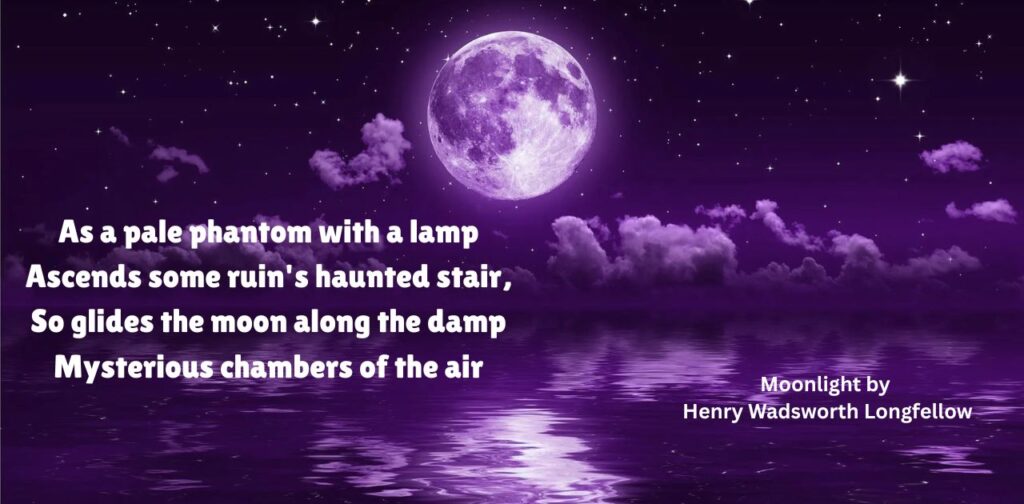
As a pale phantom with a lamp
Ascends some ruin’s haunted stair,
So glides the moon along the damp
Mysterious chambers of the air
Longfellow’s Gothic imagery transforms moonlight into a spectral presence moving through atmospheric chambers. His metaphorical language creates an otherworldly atmosphere that celebrates lunar mystery.
The poem’s supernatural undertones demonstrate how moon poetry can explore themes of mystery and transcendence through celestial imagery.
To the Moon by Percy Bysshe Shelley
Art thou pale for weariness
Of climbing heaven and gazing on the earth,
Wandering companionless
Among the stars that have a different birth
Shelley addresses the moon as a weary traveler, questioning whether its celestial journey brings loneliness rather than glory. His personification creates empathy between human experience and lunar existence.
This philosophical meditation explores themes of isolation and cosmic purpose that continue resonating with modern readers seeking meaning in astronomical observation.
The Evening Star by Edgar Allan Poe
‘Twas noontide of summer,
And midtime of night,
And stars, in their orbits,
Shone pale, through the light
Edgar Allan Poe creates a dreamlike atmosphere where stellar light penetrates temporal boundaries. His musical rhythms and mysterious imagery establish cosmic settings for supernatural narratives.
The poem’s ethereal quality showcases Poe’s mastery of using celestial elements to create psychological landscapes that blur reality and imagination.
More Posts:24+ Long Distance Relationship Poems in Hindi
Full Moon by Robert Hayden
No longer throne of a goddess to whom we pray,
no longer the bubble house of childhood’s
tumbling Mother Goose man,
The emphatic moon
Robert Hayden examines how modern perspectives have transformed lunar mythology from divine worship to scientific understanding. His contemporary voice bridges ancient reverence and rational observation.
This reflective poem demonstrates how 20th-century moon poetry grapples with scientific knowledge while maintaining emotional connections to celestial beauty.
Stars Over the Dordogne by Sylvia Plath
Stars wheel in purple, yours is not so rare
As Hesperus, nor yet so smooth a one
As round-cheeked Venus, nor so red as where
Arcturan flickers honey-coloured down
Plath combines astronomical precision with lyrical beauty, naming specific stars and celestial bodies while exploring human relationships. Her technical knowledge enriches rather than diminishes poetic emotion.
The poem showcases how contemporary stellar poetry can incorporate scientific accuracy without sacrificing artistic sophistication or emotional depth.
Hymn to the Night by Henry Wadsworth Longfellow
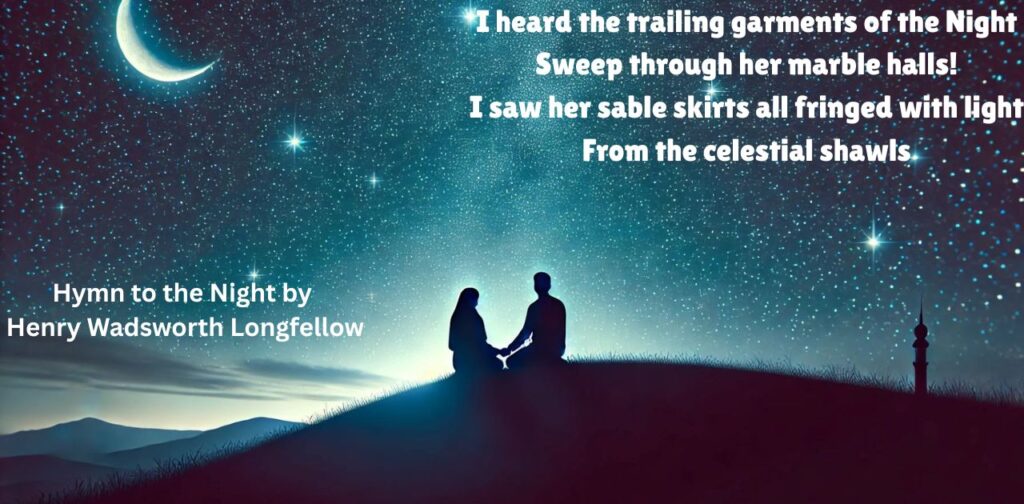
I heard the trailing garments of the Night
Sweep through her marble halls!
I saw her sable skirts all fringed with light
From the celestial shawls
Longfellow personifies night as a majestic figure adorned with stellar decorations. His rich imagery and musical verse create hymn-like reverence for nocturnal beauty.
This devotional poem demonstrates how nighttime verses can achieve spiritual significance through celestial imagery and reverential tone.
The Moon Rising by Mary Oliver
I have seen the moon rise
like a white bird
through the water,
through the dark
Mary Oliver’s nature-focused poetry captures lunar emergence through avian metaphors that suggest graceful transformation. Her observational style finds profound meaning in simple celestial moments.
The poem exemplifies contemporary nature writing that discovers universal truths through careful attention to astronomical phenomena.
Acquainted with the Night by Robert Frost
I have been one acquainted with the night.
I have walked out in rain—and back in rain.
I have outwalked the furthest city light.
I have looked down the saddest city lane
Robert Frost uses nocturnal wandering to explore human isolation and existential questioning. His repeated refrains and urban imagery create modern meditations on solitude.
This masterpiece shows how night poetry can address contemporary anxieties while maintaining universal appeal through accessible language and relatable emotions.
The Waning Moon by Percy Bysshe Shelley
And like a dying lady, lean and pale,
Who totters forth, wrapped in a gauzy veil,
Out of her chamber, led by the insane
And feeble wanderings of her fading brain
Shelley returns to lunar imagery with Gothic undertones, portraying the waning moon as a fragile figure approaching dissolution. His romantic sensibility transforms astronomical cycles into human drama.
The poem’s melancholic beauty demonstrates Shelley’s genius for finding emotional resonance in celestial observations.
More Posts:22+Kabir Das Famous Poems in Hindi
Starry Night by Anne Sexton
The town does not exist
except where one black-haired tree slips
up like a drowned woman into the hot sky.
The town is silent. The night boils with eleven stars
Anne Sexton creates surreal landscapes where stellar energy transforms ordinary settings into psychological territories. Her confessional style uses cosmic imagery to explore inner experience.
This contemporary masterpiece showcases how modern star poetry can blend personal revelation with astronomical wonder.
Moon Tiger by Penelope Fitzgerald
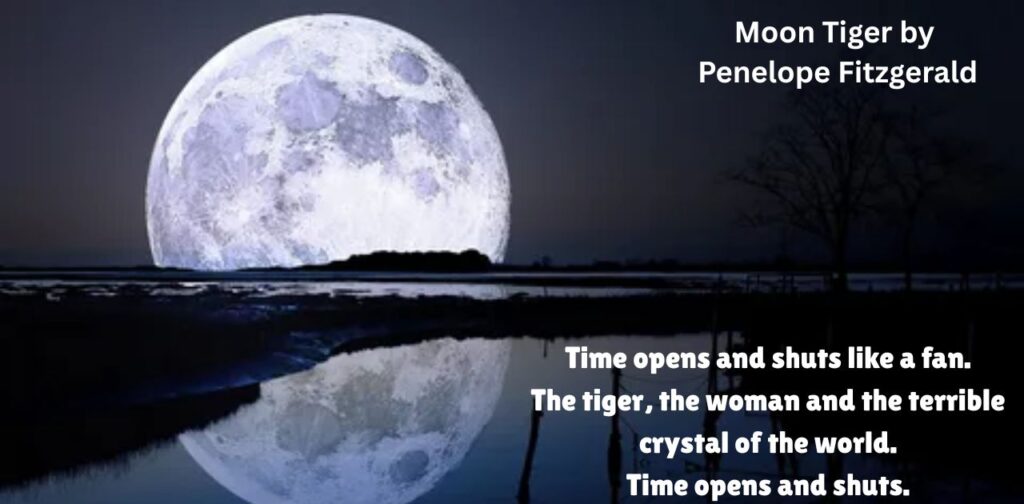
Time opens and shuts like a fan.
The tiger, the woman and the terrible
crystal of the world.
Time opens and shuts.
Fitzgerald weaves temporal themes with lunar imagery, creating complex meditations on memory and experience. Her experimental approach pushes celestial poetry into new territories.
The poem demonstrates how contemporary writers continue expanding traditional moon poetry through innovative techniques and philosophical depth.
The Stars Go Over the Lonely Ocean by Robinson Jeffers
Unhappy about some far off things
That are not my affair, wandering
Along the coast and up the lean ridges,
I saw in the evening sky the stars
Robinson Jeffers combines Pacific Coast imagery with stellar observation, creating meditative verses that explore human insignificance within cosmic vastness. His nature mysticism finds spiritual meaning in astronomical scale.
This California poet’s work demonstrates how regional landscapes can enhance universal themes in celestial poetry.
New Moon by D.H. Lawrence
The new moon, like a white shell
Washed up by night’s slow tide
On morning’s trembling shore,
Floats delicate and wide
Lawrence employs oceanic metaphors to describe lunar phases, creating sensual imagery that celebrates natural cycles. His romantic sensibility transforms astronomical events into intimate experiences.
The poem showcases Lawrence’s talent for finding erotic undertones in celestial observations, demonstrating poetry’s power to sexualize even cosmic phenomena.
Star-Talk by Robert Graves
“Are you awake, Gemelli,
This frosty night?”
“We’ll be awake till reveille,
Which is Sunrise, though
Graves personifies constellations as conversing entities, creating whimsical dialogues between stellar formations. His playful approach to astronomical subjects demonstrates poetry’s capacity for cosmic humor.
This imaginative piece shows how star poetry can achieve accessibility through anthropomorphic techniques while maintaining artistic sophistication.
The Moon’s the North Wind’s Cookie by Vachel Lindsay
The Moon’s the North Wind’s cookie.
He bites it, day by day,
Until there’s but a rim of scraps
That crumble all away
Lindsay’s childlike metaphor transforms lunar phases into digestible imagery that makes astronomical cycles understandable for young readers. His whimsical approach creates educational poetry without sacrificing artistic merit.
This accessible verse demonstrates how effective children’s poetry can teach scientific concepts through memorable imagery and rhythmic language.
Planetary by Tracy K. Smith
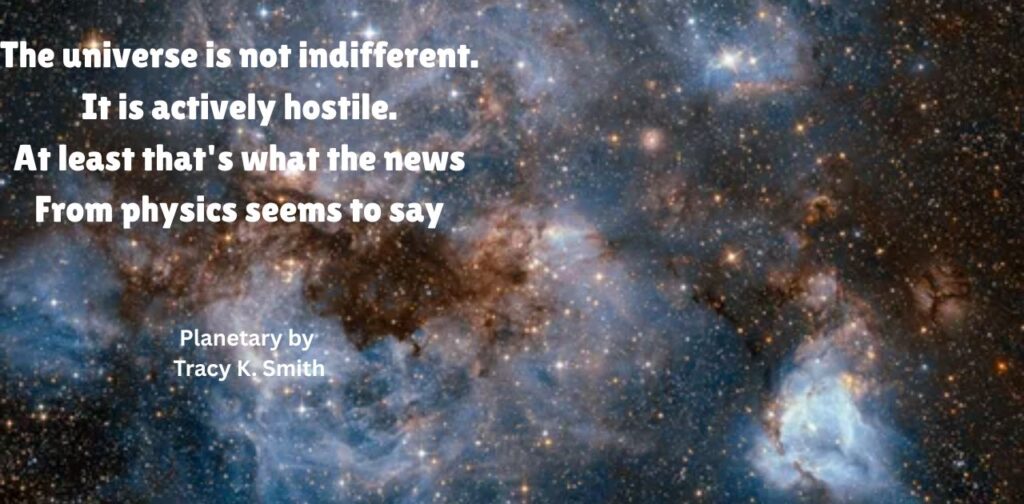
The universe is not indifferent.
It is actively hostile.
At least that’s what the news
From physics seems to say
Tracy K. Smith addresses contemporary scientific understanding of cosmic forces, exploring how modern astronomy challenges romantic notions of celestial benevolence. Her intellectual approach bridges scientific literacy and poetic expression.
This 21st-century perspective shows how current stellar poetry grapples with complex astrophysical concepts while maintaining emotional resonance.
Moonrise by Mary Oliver
When the moon rises
and the light falls down
through the air like silk,
through the windows
Oliver captures lunar illumination with tactile imagery that emphasizes moonlight’s physical presence. Her sensory approach to celestial observation creates intimate connections between readers and astronomical phenomena.
The poem exemplifies Oliver’s gift for finding spiritual significance in natural events through careful attention to sensory details.
More Posts:20+ Motivational Poems for Success in Hindi
The Stars Are Mansions Built by Nature’s Hand by William Wordsworth
The stars are mansions built by Nature’s hand,
And, haply, there the spirits of the blest
Dwell clothed in glory. Shall our grosser souls
Forever be to these bright beams sealed up
Wordsworth envisions stars as celestial dwellings for departed souls, creating architectural metaphors that bridge earthly and heavenly realms. His spiritual interpretation of astronomical observation reflects Romantic poetry’s transcendental aspirations.
This philosophical meditation demonstrates how stellar poetry can explore questions of mortality and spiritual existence through cosmic imagery.
Luna by Juan Ramón Jiménez
The moon is a curved mirror
that reflects our own desire
back to us, silver and distant,
yet strangely familiar
Jiménez transforms lunar observation into psychological reflection, suggesting that celestial bodies serve as mirrors for human emotions. His modernist sensibility creates introspective poetry through astronomical metaphors.
This Spanish poet’s contribution demonstrates how international voices enrich lunar poetry through diverse cultural perspectives on celestial experience.
Crescent Moon by Amy Lowell
The crescent moon
Is a silver boat
Sailing the sky-sea
In the evening light
Lowell employs nautical imagery to describe lunar phases, creating maritime metaphors that suggest celestial navigation. Her imagist technique achieves visual precision through economical language.
This early 20th-century work showcases how modernist approaches to moon poetry emphasize clear imagery over romantic sentiment.
The Night Sky by Li-Young Lee
Above us, only sky now, lavender
and tender where the day’s blue
turns to night, and the first stars
appear like punctuation
Li-Young Lee captures twilight transitions with contemporary sensibility, describing stellar emergence through linguistic metaphors. His multicultural perspective brings fresh approaches to traditional celestial themes.
The poem demonstrates how 21st-century poets continue finding new language for eternal human experiences of cosmic wonder.
Conclusion
These diverse poems about the moon and stars reveal humanity’s enduring fascination with celestial beauty, spanning cultures and centuries while maintaining universal appeal. Each verse transforms astronomical observation into profound artistic expression, proving that cosmic poetry remains as relevant today as ever. Whether seeking romantic inspiration or philosophical reflection, these stellar verses offer timeless connections between earthbound souls and infinite sky.

Admin of https://aspirenowa.com/. Sharing Touching and Thoughtful Poems for all Hearts. I Believe in Simple Words, Deep Meaning, and Inspiring Emotions through Poetry for Every Reader.